
A broad market position
The business had experience across residential and commercial property work, but its external positioning needed to explain more clearly which customers and contracts it wanted to pursue.
FOUNDER EXPERIENCE CASE STUDY
Northern Trade Solutions had grown quickly from a Blackpool-based property contractor into a business serving housing providers, property managers and commercial customers. The next stage required clearer direction, stronger systems and a more deliberate approach to winning and managing work.
In his role as Head of Operations, Alexander Loredan led the development of a practical growth and operational-improvement programme designed to make the business more structured, commercially prepared and easier to scale.

This case study documents Alexander Loredan’s work as Head of Operations at Northern Trade Solutions Ltd. NTS is not presented as a paid Blueprint SME client. It is included to demonstrate the hands-on operational and commercial experience behind Blueprint’s approach.
AT A GLANCE
Build the structure, visibility and commercial preparation needed to support controlled regional growth.
Strategic direction, commercial positioning, procurement and tender readiness, business systems, operational structure, website and digital positioning, commercial business development, and performance and growth planning.
THE CONTEXT
Northern Trade Solutions was established in Blackpool in 2023 and built its early growth through property repairs, maintenance, refurbishment and wider building work.
The business developed a strong base of operational knowledge and repeat work. It was also beginning to work with larger housing, property-management and commercial organisations whose expectations extended beyond completing the physical work.
Larger customers wanted clearer evidence, stronger processes, organised documentation and confidence that the contractor could manage work consistently. This meant the next stage of growth could not rely only on trade capability and reputation.
NTS needed to strengthen the business behind the service. That included how it positioned itself, prepared for procurement, organised information, managed growth and communicated its offer to the market.
The challenge was not simply to win more work. It was to make sure the business was ready to manage better work properly.
THE CHALLENGE
Like many owner-managed SMEs, NTS had developed through practical delivery and fast decision-making. Those strengths had helped the business grow, but the next stage required more of its knowledge and direction to be recorded, organised and shared.
The business had experience across residential and commercial property work, but its external positioning needed to explain more clearly which customers and contracts it wanted to pursue.
The business wanted to increase its work with housing providers, property managers, public bodies and commercial organisations. This required a defined growth route rather than isolated sales activity.
Larger customers expected organised policies, insurance details, competency information, case studies, service evidence and clear tender responses.
Processes, responsibilities and commercial information needed to become less dependent on individual memory and repeated explanations.
The business needed clearer use of its existing systems for leads, quotations, scheduling, records and performance information.
Growth alone was not enough. Decisions about customers, recruitment and regional expansion needed to consider operational capacity, service quality and healthy margins.
The solution needed to connect strategy, operations, procurement and commercial development rather than treating each issue separately.
THE OBJECTIVES
Alexander defined a connected set of priorities for the business.
Every improvement needed to be practical enough for a busy SME to use, not simply look impressive in a report.
WORKSTREAM 01
Alexander began by bringing the business’s ambitions, current position and commercial opportunities into one clearer strategic view.
The strategy protected the business’s established operating areas across Blackpool, the Fylde Coast, South Ribble and West Lancashire while identifying sensible next-stage opportunities in Lancaster and Morecambe, East Lancashire, Southport and Cumbria.
Longer-term expansion was treated as a later growth stage, dependent on management capacity, systems and operational readiness.
Expansion decisions were linked to practical conditions such as contract demand, staffing, management capacity, service performance, systems and financial control.
The long-term direction focused on becoming a trusted regional property-services contractor. Specific financial ambitions and forecasts are not included in this public case study.
WORKSTREAM 02
A major part of the work was the development of the NTS Operating System, bringing strategy, market understanding, processes, responsibilities and working standards into a connected set of documents.
The operating framework records the business’s ambition, priorities, target customers, geographic direction and growth conditions.
Competitor and market analysis was developed to identify where larger regional contractors were strong and where a responsive, well-organised SME could compete differently.
The framework was designed to support an operations manual, tender library, HR guidance and quality-management materials.
The operating system provides a reference point so growth activity can be tested against agreed priorities rather than driven by every new opportunity.
The purpose was not to create paperwork for its own sake. It was to give the business a clearer way to make decisions and repeat good work.
WORKSTREAM 03
NTS had historically completed a significant amount of residential work. The growth strategy required a clearer commercial position while retaining the ability to serve appropriate residential customers.
The commercial service structure was organised around shop fitting and refits, reactive repairs and maintenance, void property works, planned maintenance, commercial refurbishment and facilities-management support.
The business identified relevant sectors including housing associations, property management, commercial offices, hospitality, retail, education, healthcare and industrial organisations.
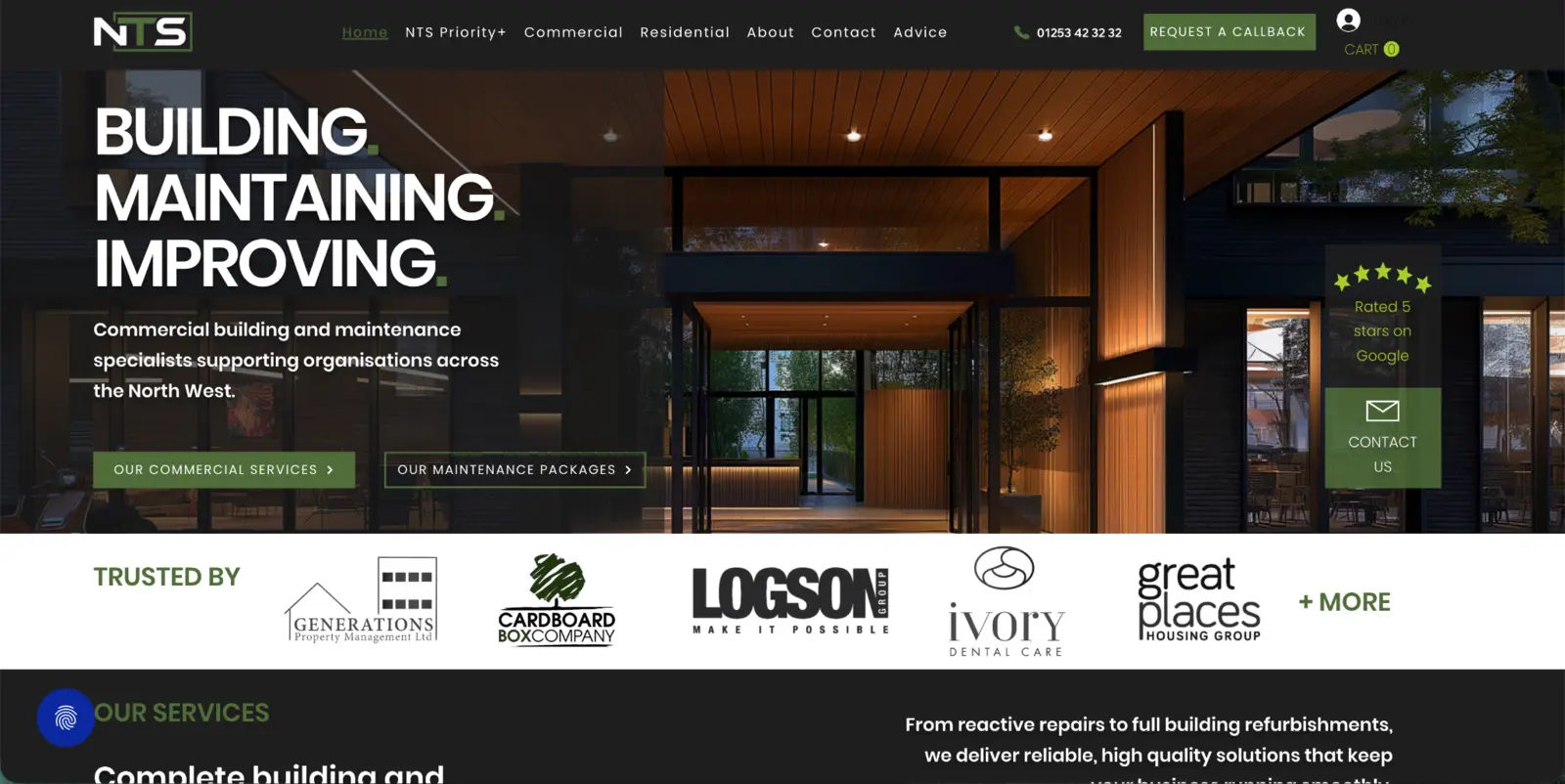
The message was updated to reflect NTS as a commercial contractor serving Lancashire and the North West, supported by the line “Building. Maintaining. Improving.”
The website and wider digital presence were reviewed to support commercial credibility, procurement discovery and clearer communication of services, sectors and operating areas. This case study does not claim that every planned website or SEO improvement is complete.
WORKSTREAM 04
Commercial growth required more than identifying potential customers. NTS needed to make it easier for procurement teams to assess the business and understand its capability.
A structured approach was developed for storing approved company information, policies, insurance details, service evidence and reusable tender content.
Relevant examples of responsive repairs, void works, refurbishment, planned maintenance and commercial support were identified for future submissions.
Existing evidence such as CHAS approval, risk assessments, method statements, toolbox talks, PPE arrangements, competency checks and working-at-height controls was organised.
Insurance details, company background and service information were brought into the procurement-readiness process.
A more deliberate approach was developed for identifying and contacting decision-makers across councils, housing providers, property managers and commercial organisations.
Tender and contract opportunities were considered against service fit, operating geography, delivery capacity, commercial value and evidence requirements.
Readiness work cannot guarantee acceptance by a procurement team or the award of a contract.
WORKSTREAM 05
Alexander developed a more targeted approach to business development using defined customer groups, procurement contacts and direct outreach.
Commercial development focused on housing providers, councils, property managers, facilities-management organisations, hospitality businesses and other organisations responsible for property portfolios.
Contact lists and outreach activity were built around relevant procurement, property, facilities and operational decision-makers.
The approach connected initial outreach with procurement onboarding, quotation activity and follow-up rather than treating contact generation as the final result.
As outreach grew, the process was adjusted to avoid detailed tracker administration taking more time than the commercial activity itself.
The aim was a focused commercial process that the business could maintain, not a reporting system that became a job in its own right.
WORKSTREAM 06
The proposed organisational structure was developed around clear reporting lines and practical management responsibilities.
The proposed route was designed around operatives reporting through site supervision and contract management to the Head of Operations.
A future planning role was identified to coordinate the work diary and improve how jobs, resources and commitments are organised.
Customer coordination, finance and compliance responsibilities were grouped under the Finance and Business Support function.
The proposed rhythm focused on weekly tactical meetings, monthly strategic reviews, major-project briefings and quarterly one-to-ones, avoiding unnecessary daily meetings.
The structure was designed to create clearer ownership without adding management positions before the workload justified them.
WORKSTREAM 07
NTS already used Simpro to support leads, scopes, quotations, scheduling and job records. The improvement programme focused on making better use of that system and the information around it.
A clearer route was developed from initial opportunity through scoping, quotation, scheduling and follow-up.
The business established an internal aim of issuing quotations within three working days where the information required to price the work was available. This is not an unconditional customer guarantee.
Better records support customer communication, evidence gathering, tender responses and future performance review.
Plans were developed for clearer operational indicators, monthly board reporting and decision-making based on actual business performance.
Growth planning considered margin, workload, service quality and operational capacity instead of using turnover as the only measure of success. No internal financial figures are published here.
THE OUTCOMES
The programme involved work by Alexander, NTS directors, employees and external partners. The outcomes below are business-wide progress rather than the result of one person acting alone.
NTS established a clearer ambition to become a trusted regional property-services contractor, supported by phased geographic priorities and practical growth conditions.
The business’s external message became more focused on the needs of housing providers, property managers and commercial organisations.
Company information, policies, evidence and tender materials became more organised and easier to use when procurement opportunities appeared.
During this period, NTS secured trusted-contractor status with a local authority and a property-management business, creating immediate opportunities for new work.
The business progressed through formal procurement with a hospitality organisation while continuing to develop relationships across property and facilities management. Pending opportunities are not presented as secured contracts.
The NTS Operating System created a structured base for future operations, quality, tender and people documentation.
The business developed a proposed structure for contract management, supervision, planning and business support that could be introduced as workload and capacity required it.
The strategy connected growth decisions to service quality, management capacity, operational readiness and commercial control.
THE BLUEPRINT CONNECTION
The work at NTS reinforced a central idea behind Blueprint SME: a growing business rarely needs advice on only one isolated issue.
Commercial positioning affects who finds and trusts the business. Procurement readiness depends on policies, evidence and working practices. Growth planning depends on operational capacity. Business systems determine whether good work can be repeated consistently.
Blueprint was created to bring these connected areas together and turn them into practical work that an SME can use.
These links describe services available through Blueprint SME. They do not change the employment relationship under which the NTS work in this case study was completed.
PRACTICAL LESSONS
Policies, insurance details, case studies and standard company information are easier to prepare before an opportunity appears.
New areas, customers and roles should be linked to capacity, systems, demand and commercial performance.
Documenting useful processes makes them easier to repeat, improve and explain to new employees and customers.
A website should explain the business you are building, not only the work that created its early growth.
A process should save time, improve control or reduce risk. If the administration becomes more demanding than the work, the system needs simplifying.
BUILD WHAT COMES NEXT
Blueprint helps SME owners clarify the direction, strengthen the systems and complete the practical work needed for the next stage of growth.
Start with what is happening now. We will help you identify the clearest next step.